

Introduction
Travel in 2026 is no longer just about getting from one place to another. It is about navigating a highly connected, fast-moving global system where prices shift in real time, experiences are more accessible than ever, and decisions made before departure shape the entire journey.
This is where smart travel tips become essential for every modern traveler.
While travel has become easier, it has also become more complex. Flight prices fluctuate constantly, accommodation options are overwhelming, and travel information is scattered across hundreds of platforms. Without a clear strategy, even experienced travelers can end up overspending, wasting time, or missing out on better experiences.
A well-informed approach helps you cut through this complexity and make better decisions at every stage of your journey.
This guide brings together 25 essential, field-tested smart travel tips designed to help you travel smarter, not harder. These are practical habits and decision-making strategies that separate rushed, stressful trips from smooth, well-executed journeys anywhere in the world.
Table of Contents
PLANNING & BOOKING STRATEGY
1. Book Flights within the Smart Window
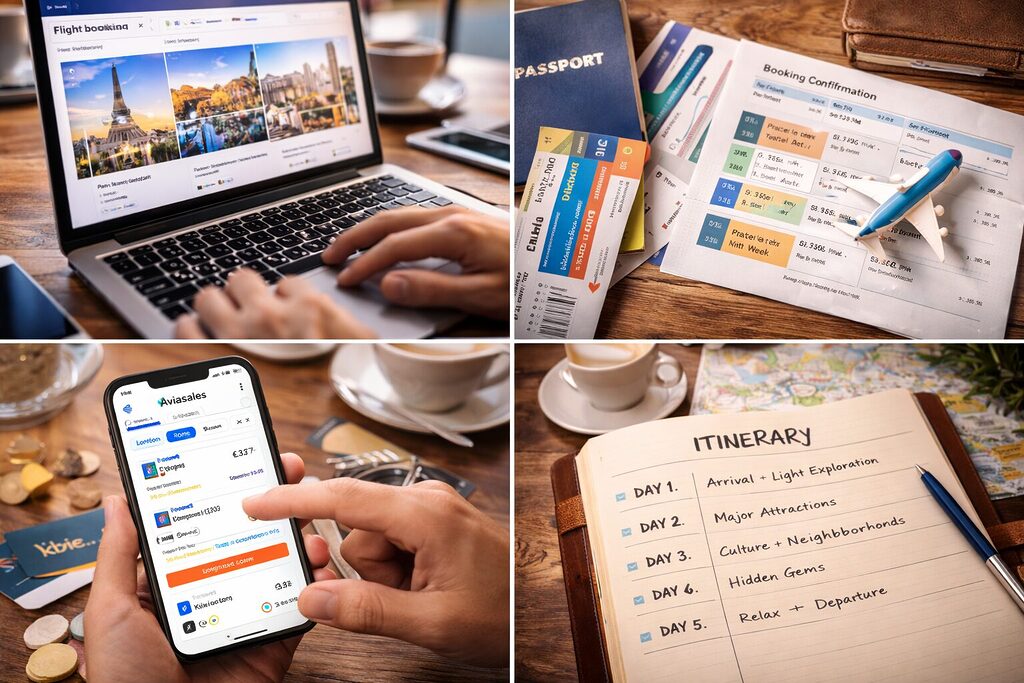
Smart planning and booking strategies can help you save money and avoid unnecessary travel stress.
One of the most common mistakes travelers make is assuming that booking as early as possible guarantees the lowest price. In reality, the most effective smart travel tips often go against this assumption.
Airlines now use dynamic pricing systems that adjust constantly based on demand, seasonality, route popularity, and user search behavior. This means flight prices rarely follow a simple “early is cheaper” rule. You can monitor real-time fluctuations using tools like Google Flights.
For most routes, the optimal booking window is typically 2 to 8 weeks before departure. During this period, prices tend to stabilize after initial fluctuations and before last-minute demand spikes begin to drive fares upward.
Using this timing strategy is one of the most practical smart travel tips for consistently securing better airfare deals without the stress of constant monitoring.
Insight:
Booking too early often results in “anticipation pricing,” where fares are still inflated due to uncertainty. On the other hand, booking too late exposes you to “scarcity pricing,” where limited seat availability drives costs significantly higher.
2. Never Rely on a Single Booking Platform
One of the most effective smart travel tips for saving money on flights is understanding that prices are not universal across booking platforms. The same seat on the same flight can appear at different prices depending on where and how you search.
This happens because different platforms have unique airline partnerships, negotiated fares, promotional deals, and bundled pricing structures that are not always visible elsewhere.
That is why experienced travelers always compare multiple platforms before making a final decision. Common examples include:
Platforms like Google Flights or Skyscanner help you compare fares across multiple airlines instantly.
Each platform may offer different combinations of discounts, routes, or additional perks such as flexible tickets or bundled hotel deals.
This comparison habit is one of the simplest yet most powerful smart travel tips for consistently finding better travel deals without needing advanced tools or complex strategies.
Traveler mindset:
Think of booking platforms as different markets. You don’t shop in just one store when prices can vary—you compare options to find the best value before committing.
3. Flexibility is Your Greatest Money-Saving Tool
One of the most valuable smart travel tips for reducing travel costs is understanding that flexibility often matters more than timing or even early booking.
In many cases, simply shifting your departure or return date by as little as 24 hours can lead to significant differences in airfare prices. This is because airline pricing systems are driven primarily by demand patterns, not fairness or fixed pricing logic.
Flights on peak days or high-demand time slots are often priced much higher, while nearby dates may offer substantially lower fares for the exact same route and cabin class.
Airlines adjust prices dynamically based on booking trends, seasonality, and seat availability. As a result, travelers who remain flexible naturally gain access to better pricing opportunities.
This makes flexibility one of the most reliable smart travel tips for consistently reducing travel expenses without compromising on destination, comfort, or experience.
Traveler insight:
Airlines do not reward rigidity—they reward timing and demand gaps. Flexible travelers are simply positioned to take advantage of those gaps before they disappear.
4. Mid-Week Travel Almost Always Wins
One of the most reliable smart travel tips for saving money on flights is understanding how travel demand shifts throughout the week.
Tuesdays and Wednesdays are often the lowest-demand travel days, which means airlines frequently price flights more competitively during this period. With fewer business and leisure travelers flying mid-week, airlines tend to lower fares to fill remaining seats.
In contrast, weekend travel is usually more expensive due to convenience-driven demand. Fridays and Sundays, in particular, are peak travel periods where prices are typically inflated because most travelers prefer to depart or return on these days.
This simple timing adjustment can make a noticeable difference in overall travel costs, especially for frequent or long-distance trips.
Pro tip:
Even small changes to your itinerary, such as shifting your departure or return to a mid-week day, can unlock meaningful savings without affecting your destination or travel experience.
5. Leverage Price Alerts as Strategic Tools
One of the most effective smart travel tips for booking flights is using price alerts not just as notifications, but as strategic decision-making tools.
Instead of guessing the right time to book, price alerts allow you to monitor fare changes over time and understand how prices behave across days or weeks. Tools like Google Flights allow you to set price alerts and track fare changes over time. This gives you visibility into natural price fluctuations, including dips, spikes, and stable periods within the booking cycle.
By tracking these trends, travelers can identify the best booking moments with far greater accuracy, rather than relying on intuition or last-minute decisions.
This data-driven approach is what separates casual booking behavior from strategic travel planning.
Traveler insight:
Smart travelers do not chase deals impulsively. Instead, they allow the system to reveal pricing patterns, then act when the timing is most favorable.
MONEY & BUDGET INTELLIGENCE
6. Always Build a Financial Buffer (10–20%)
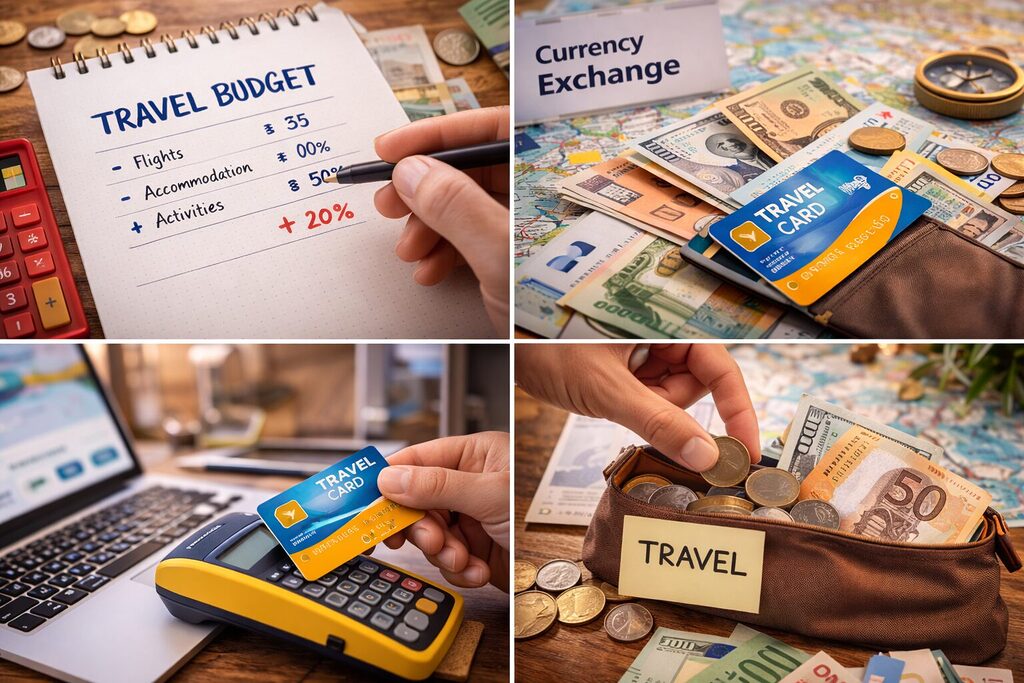
Smart Travel budget planning with notebook, currencies, credit card and cash for international trip
One of the most overlooked smart travel tips in travel planning is preparing for financial flexibility through a built-in budget buffer.
Even the most carefully planned trips often come with unexpected expenses such as transport changes, last-minute attraction fees, tipping culture variations, currency fluctuations, or spontaneous experiences that are too good to miss.
Without a financial buffer, these moments can quickly create stress or force compromises during your trip. With one in place, they become part of the experience instead of a disruption.
A recommended buffer of 10–20% of your total travel budget ensures you can handle surprises comfortably while maintaining control over your overall spending.
This approach allows you to stay flexible, confident, and fully present during your journey—without constantly worrying about exceeding your planned budget.
Traveler insight:
Smart travelers do not aim to eliminate surprises. They prepare for them in advance so every unexpected moment remains enjoyable, not stressful.
7. Use Travel-Friendly Banking Systems
One of the most practical smart travel tips for international travelers is choosing banking systems designed specifically for global use.
Many travelers lose money without realizing it due to hidden financial charges that accumulate during trips. These often include foreign transaction fees, unfavorable exchange rates, and ATM withdrawal penalties that quietly increase overall travel costs.
Travel-friendly debit and credit cards are designed to minimize or eliminate these charges, allowing you to spend and withdraw money internationally without unnecessary losses. Services like Wise help travelers reduce hidden FX fees and improve exchange rates.
By using the right financial tools, you ensure that your money retains its full value throughout your journey instead of being reduced by avoidable fees.
Smart traveler behavior:
Your money should move with you seamlessly across borders, not lose value each time you make a transaction abroad.
8. Never Depend on a Single Payment Method
A truly prepared traveler always builds financial redundancy so they are never stuck without access to money.
Relying on one card or one wallet system can quickly become a problem if it gets lost, blocked, or stops working abroad.
Smart setup includes:
- Primary debit/credit card for everyday spending
- Backup card stored separately (not in the same wallet or bag)
- A small amount of local cash for emergencies, transport, or places that don’t accept cards
Why this matters:
- Cards can be declined unexpectedly in foreign countries
- ATMs can swallow or block cards without warning
- Mobile payment systems may fail due to network or verification issues
The goal is simple: if one method fails, another immediately takes over—so your travel doesn’t pause because your payment did.
9. Avoid Airport Currency Exchange at All Costs
Airport currency exchange services prioritize convenience, not value. Because travelers have limited options once they arrive, these counters often apply some of the least favorable exchange rates available.
In practice, this means you lose more money for the same amount exchanged—simply due to location.
A smarter approach:
- Exchange money in city centers, where competition leads to better rates
- Use ATMs linked to low-fee international cards for withdrawals at near-market rates
- If possible, compare rates briefly before committing to any exchange
Why this matters:
Even small rate differences compound over a trip, especially for longer stays or multiple withdrawals. What feels like a minor loss per transaction can become a significant travel expense overall.
10. Maintain Daily Financial Tracking
Most travelers only realize they’ve overspent after the trip is already over—and by then, it’s too late to adjust anything.
Daily financial tracking prevents that by keeping your spending visible in real time, so your budget stays under control throughout the journey instead of drifting silently off course.
It doesn’t need to be complicated:
- Quick end-of-day notes of what you spent
- A simple budgeting app or spreadsheet
- Categorizing basics like transport, food, lodging, and extras
Why it works:
- You catch overspending early, not after the fact
- You make better decisions on the next day’s spending
- You reduce “invisible leaks” like small, repeated purchases
The goal isn’t restriction—it’s awareness. When you can see your spending clearly each day, you stay in control of the overall trip budget without stress.
PACKING & PREPARATION MASTERY
11. Pack Light—Because Mobility is Freedom

Packing smart with a checklist and organized suitcase helps you travel lighter and more efficiently.
Heavy luggage doesn’t just slow you down physically—it quietly reduces your flexibility and adds unnecessary friction to every part of your journey.
When you carry less, you move differently. You make decisions faster, navigate transport more easily, and avoid the constant background stress of managing “stuff.”
Light packing allows you to:
- Move faster through airports, stations, and cities
- Avoid baggage stress, delays, and extra fees
- Adapt plans easily without logistical burden
- Stay more mentally flexible when travel changes unexpectedly
Why it matters:
The less you carry, the less you have to manage—and that directly increases your freedom to explore, change direction, or take spontaneous opportunities.
The best travelers don’t look weighed down by preparation. They move like the city itself—fluid, responsive, and unburdened.
12. Use a Packing Checklist Every Time
Even experienced travelers forget essentials when packing from memory. The problem isn’t lack of experience—it’s the assumption that familiarity replaces structure.
A checklist removes uncertainty from the process and ensures nothing important is left behind, regardless of how many trips you’ve taken.
With a simple checklist, you:
- Avoid last-minute panic packing
- Ensure consistency across different trips
- Reduce the mental load before departure
- Prevent costly or inconvenient missing items
You can also use digital packing tools like Notion or Google Keep to standardize your checklist across trips.
Why it matters:
Packing is one of those tasks where small oversights create outsized problems—forgetting a charger, documents, or essentials can disrupt the entire start of a trip. A checklist turns packing from a reactive scramble into a repeatable system.
13. Roll Clothes Instead of Folding
This is more than a packing preference—it’s a small system upgrade that improves how you use space and stay organized on the move.
Rolling clothes instead of folding helps you:
- Save significant space in your luggage
- Reduce wrinkles compared to traditional folding
- Improve suitcase organization and visibility of items
Why it works:
Rolled clothing fits more efficiently into gaps inside your bag, creating a more structured layout where everything is easier to access without unpacking everything.
Among practical smart travel tips, this is one of the simplest changes that immediately improves packing efficiency and keeps your luggage more manageable throughout your trip.
14. Pack for Versatility, Not Quantity
One of the most effective smart travel tips is shifting your mindset from packing more items to packing more combinations.
Instead of bringing a large number of outfits, focus on selecting pieces that can work together in multiple ways.
A simple rule:
Each item should pair well with at least two others in your luggage.
This approach helps you:
- Reduce overall luggage weight
- Maximize outfit combinations from fewer pieces
- Avoid “single-use” clothing that takes up space
- Adapt your style to different settings without overpacking
Why it matters:
Versatile packing turns a small wardrobe into a flexible system. You’re not packing outfits—you’re packing building blocks that can be rearranged depending on the situation.
15. Keep Critical Items in Your Carry-On
Your carry-on is not just a secondary bag—it’s your travel safety net. Among all smart travel tips, this one directly protects you from the most disruptive travel failures: delayed, lost, or mishandled checked luggage.
Anything essential for your identity, health, or immediate survival during travel should always stay with you.
Always include in your carry-on:
- Passport and travel documents
- Medications and basic health essentials
- Electronics (phone, charger, power bank, laptop if needed)
- Essential valuables (wallet, cards, important keys, jewelry if applicable)
Why it matters:
Checked luggage is outside your control once it’s handed over. If it is delayed or lost, you can still function normally as a traveler if your critical items are with you. Without them, even a simple delay can turn into a serious disruption.
The principle is simple: if you cannot replace it quickly in a foreign place, it does not go in checked luggage.
TRAVEL EXPERIENCE OPTIMIZATION
16. Leave Tourist Zones to Discover Real Cities

Authentic travel experiences come from exploring local culture, trying new foods, and connecting with people.
Tourist attractions show you a destination’s highlights—but neighborhoods show you its identity. This is where the everyday rhythm of a place becomes visible: how people live, eat, commute, and spend their time when they are not performing for visitors.
Many travelers stay within central tourist districts and end up seeing a polished version of a city that feels exciting but incomplete. The deeper character of a place usually exists just a few streets away from those zones.
The real culture of a city often exists outside the guidebook routes—inside local markets, residential streets, small cafés, community spaces, and everyday transit areas where life continues without staging.
Why this matters:
Stepping beyond tourist zones shifts your experience from observation to immersion. Instead of just seeing a destination, you begin to understand how it actually works.
Among practical smart travel tips, this is one of the most effective ways to turn travel from surface-level sightseeing into meaningful cultural experience.
17. Food is Not an Activity—It’s Cultural Access
Food in travel is often treated as a checklist item or a break between attractions, but it functions as something far deeper. It is one of the most direct ways to understand place, history, and identity without needing explanation or translation.
Every dish reflects layers of culture—what ingredients are available, how people adapt to their environment, and what traditions have been preserved or changed over time.
Even simple street food can carry more cultural meaning than major landmarks because it is connected to daily life rather than curated presentation. It shows what people actually eat, not what is displayed for visitors.
Why this matters:
When you approach food as cultural access instead of just consumption, your entire travel experience becomes more immersive. You are no longer just visiting a place—you are experiencing how it expresses itself through taste, habit, and tradition.
Among smart travel tips, this mindset shift turns meals into one of the most meaningful parts of the journey rather than just logistical stops between activities.
18. Learn Basic Local Phrases
Even minimal effort with the local language can change how people respond to you in meaningful ways. You don’t need fluency—just a few basic words are often enough to signal respect and awareness.
Simple greetings, thank-yous, and polite expressions can shift interactions from purely transactional exchanges to more human, open, and patient responses. People generally appreciate the effort, even if pronunciation isn’t perfect.
Why this matters:
Language is more than communication—it’s a social signal. When you make even a small attempt, you’re no longer treated as a distant outsider but as someone engaging with the culture.
Among smart travel tips, this is one of the simplest ways to improve daily travel experiences, especially in markets, small shops, local transport, and casual street interactions.
19. Start Early: Every City Has a Morning Side
Cities are not static—they change personality depending on the time of day. Morning is when many destinations feel most authentic and least influenced by tourism or rush.
Early mornings reveal a quieter, more natural version of a place, before crowds, traffic, and commercial activity fully take over.
In this window, you often get:
- Quiet streets and open public spaces
- Better lighting and photography conditions
- A clearer view of local routines unfolding naturally (commutes, markets setting up, cafés opening)
Why this matters:
Morning travel shifts your experience from curated environments to lived reality. You see a city before it becomes “performative,” which often leads to a deeper appreciation of its rhythm and structure.
Among smart travel tips, starting early is one of the simplest ways to upgrade the quality of your entire day without changing your itinerary—just your timing.
20. Accept That Plans Will Change
No matter how carefully a trip is planned, travel always introduces unpredictability. Delays, weather shifts, local conditions, or spontaneous opportunities can all reshape your original schedule.
Rigid planning often creates unnecessary frustration when reality doesn’t match expectations. Flexible thinking, on the other hand, turns disruptions into part of the experience rather than problems to solve.
The most rewarding moments in travel often come from unexpected changes—detours that lead to better places, unplanned conversations, or discoveries that were never on the itinerary.
Why this matters:
When you stop treating your plan as fixed, you start responding to travel as it actually is: dynamic, shifting, and full of variables you cannot fully control.
Among smart travel tips, this mindset is essential for reducing stress and increasing the quality of real-world experiences. Flexibility doesn’t weaken your plan—it makes it usable in real conditions.
SAFETY & SMART TRAVEL SYSTEMS
21. Travel Insurance Is Essential, Not a Luxury
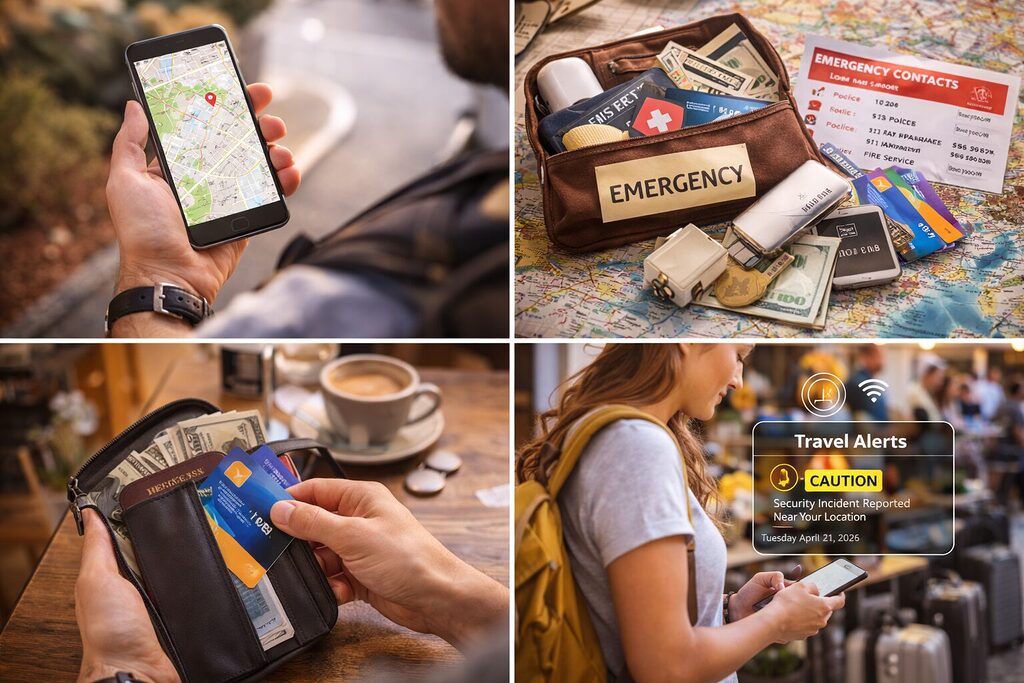
Staying safe while traveling involves preparation, awareness, and using smart digital tools.
Travel insurance is often overlooked until the moment it becomes necessary—and by then, it’s the one thing you wish you had arranged earlier.
Unexpected situations can happen on any trip, regardless of how well it is planned. Having coverage in place ensures that a single disruption doesn’t turn into a major financial setback.
A solid travel insurance plan typically protects against:
- Medical emergencies and hospital treatment abroad
- Trip cancellations or unexpected interruptions
- Lost, delayed, or stolen baggage
Why this matters:
Healthcare systems, airline policies, and emergency costs vary widely across countries. Without insurance, even a minor incident can become expensive and logistically complicated. With it, you shift risk away from yourself and travel with far more confidence.
Among smart travel tips, this is one of the most important safety foundations—because it protects everything else in your trip from being derailed.
If you want to stay protected while traveling, you can compare trusted travel insurance options here.
22. Digital Copies Are Your Backup Reality
In travel, physical documents are vulnerable—loss, theft, damage, or simple misplacement can happen when you least expect it. That’s why digital backups function as your second layer of identity and access.
Having secure digital copies ensures that even if something goes wrong physically, you still have the information needed to recover quickly and continue your trip.
Store key documents in secure systems such as:
- Cloud storage (with strong authentication enabled)
- Encrypted note or file storage apps
- Password-protected folders on your device
Important documents to back up:
- Passport and ID
- Visas and travel permits
- Flight and hotel confirmations
- Insurance details (especially important when linked to your smart travel tips travel insurance plan)
Why this matters:
Losing documents abroad can create delays, stress, and expensive administrative processes. Digital copies don’t replace originals—but they give you immediate access to critical information when you need it most.
23. Offline Maps Are Non-Negotiable
Connectivity is not guaranteed everywhere, especially when traveling through unfamiliar cities, rural areas, or underground transport systems. Relying solely on mobile data or Wi-Fi can leave you stranded at the exact moment you need direction the most.
Offline maps ensure you remain oriented even without internet access, allowing you to navigate confidently regardless of signal availability.
Most navigation apps allow you to download maps in advance so you can:
- Find your location without data
- Navigate routes, streets, and landmarks offline
- Avoid getting lost in low-connectivity areas
- Reduce dependence on roaming or unstable networks
Google Maps allows offline downloads so you can navigate without data.
Why this matters:
Navigation is one of the most fundamental travel needs. Losing access to it, even temporarily, can create avoidable stress and delays. Offline access turns your phone into a reliable tool instead of a dependent one.
Among smart travel tips, this is a simple preparation step that prevents disproportionately large problems in real-world travel situations.
24. Awareness is the Simplest Form of Safety
Most travel risks are not dramatic or rare events—they are situational and happen in ordinary environments like crowded streets, public transport, markets, and tourist hotspots.
Staying aware of your surroundings is one of the most effective layers of protection you can build into your trip, and it doesn’t require any special tools—just attention.
Being alert in crowded areas significantly reduces vulnerability because it helps you:
- Notice unusual behavior early
- Keep better control of your belongings
- Avoid distractions in high-traffic environments
- Make quicker decisions when situations change
Why this matters:
Many travel incidents happen not because of extreme danger, but because attention is divided. Awareness reduces those small gaps where mistakes or opportunistic risks occur.
Among smart travel tips, this is one of the simplest and most consistently effective safety habits—because it is always available, in every location, at every moment.
25. Share Your Itinerary for Safety Transparency
Letting someone you trust know your travel plan creates an important external safety layer. It ensures that even when you are fully independent on the road, someone else still has visibility into your general movements.
This is not about fear or restricting your freedom—it’s about building preparedness into your travel routine.
A simple shared itinerary can include:
- Flight details and arrival times
- Accommodation information
- General day-by-day movement plans (not overly detailed)
- Key contact information for your trip
Why this matters:
If something unexpected happens—delays, missed check-ins, or emergencies—someone already has the basic information needed to respond or assist quickly. It adds structure to uncertainty without limiting your flexibility.
Among smart travel tips, this is one of the most understated safety practices, but also one of the most effective for peace of mind on both sides.
KEY TAKEAWAYS
- Travel success is built before departure, not during the trip
- Flexibility consistently saves more money than aggressive planning
- Packing light increases both mobility and enjoyment
- Local experiences matter more than checklist tourism
- Smart systems reduce stress more than effort does
BEST FOR
- First-time international travelers
- Frequent travelers optimizing costs
- Solo travelers prioritizing safety
- Anyone wanting more intentional, stress-free travel
FREQUENTLY ASKED QUESTIONS
What is the most important travel principle?
Preparation with flexibility—structure without rigidity.
How do I travel cheaper in 2026?
Use flexible dates, compare platforms, avoid peak seasons, and track prices strategically.
Is international travel still safe?
Yes—when supported by awareness, insurance, and preparation systems.
What is the biggest mistake travelers make?
Overplanning without leaving room for real-world unpredictability.
Plan Your Next Journey with AxTravel
Continue exploring curated travel content designed to help you travel smarter, better, and more meaningfully.
- Discover unforgettable travel experiences around the world
- Read our travel tips to prepare better for your journeys
- Find the best travel deals to save money and travel more
- Explore our travel guides for top destinations
- Secure your trip with comprehensive travel insurance cover
CONCLUSION
Smart travel is not defined by how far you go, but by how well you move through the world.
When you combine preparation, flexibility, awareness, and strategy, travel becomes less about managing problems and more about experiencing moments. Each decision—before and during your trip—shapes how smooth, efficient, and rewarding the journey becomes.
This is the essence of smart travel tips: turning uncertainty into structure, and turning structure into freedom.
At AxTravel, we believe that the best journeys are not just planned—they are intelligently designed.
Use these 25 principles as your foundation, and every trip you take in 2026 will feel smoother, richer, and more intentional.
Support Independent AxTravel Guides
If you found this guide helpful, consider supporting AxTravel. Your contribution helps us continue creating trusted travel guides, destination research, and practical travel resources for travellers around the world.
Your support helps keep independent travel guides free and accessible to everyone.
✍️Written by the AxTravel Travel Desk
Helping you explore the world with trusted guides, tips, and inspiration.


What I gather mostly from this is the the financial planning that make it easier for me too sleep at night. I wouldn’t want too be in a foreign plan and be stuck with out enough money, for unseen situations, so I now know that I need proper planning ,even there is mechanisms so that you don’t miss out on a great experience and getting your money’s worth. This site is top-notch.
I am a travel addict and I love this website because it goes into deep to explain and give you a clear view of each destination. You can’t help but fall more in love with traveling. I now want to travel to New destinations because of axtravel.
This is one of the most practical travel guides I’ve come across in a while. I really appreciate how you focused on smart, real-world tips instead of generic advice. The sections on budgeting and staying flexible really stood out to me, especially with how unpredictable travel can be these days. Definitely saving this for my next trip!
This was such a helpful and well-put-together guide—thank you for sharing! I really appreciated the practical tips, especially around planning ahead and staying flexible while traveling. It’s easy to get caught up in trying to control every detail, but your advice reminds me that some of the best experiences come from being open to the unexpected. I’ll definitely be applying a few of these on my next trip!
I will give this thread a 5 stars because it help me a lot start from with the preparation, until the execution for the plan, indeed we need to be more aware and flexible when we go to travel, it will help us to reduce the cost and efficient when travelling
This is a must-read article. These tips are great for travel plans ahead in 2026. I do not tend to travel very often, but when I do I will be sure to remember these recommendations. This is such a helpful article and I appreciate the emphasis on important reminders like backing up documents, which is essential for every traveler. I also really liked the focus on offline maps as a non-negotiable, since getting around can often be challenging. Overall, this is a very detailed and useful guide for travel planning in 2026. I can’t wait to book my next vacation.
Really great tips for travelers. These tips gave me a lot of reminders on how to arrange my next trip planning. One of the insights I got is that mid-week travel is the best choice. Thank you.
Really solid list! The tips on booking flights in that 2-8 week sweet spot, rolling clothes, and keeping critical items in your carry-on are pure gold. I especially loved the reminder to get off the tourist path and treat food as cultural access — that’s what turns a good trip into an unforgettable one.
These 25 tips feel practical and up-to-date for 2026. Definitely saving this for my next adventure. Thanks AxTravel!